

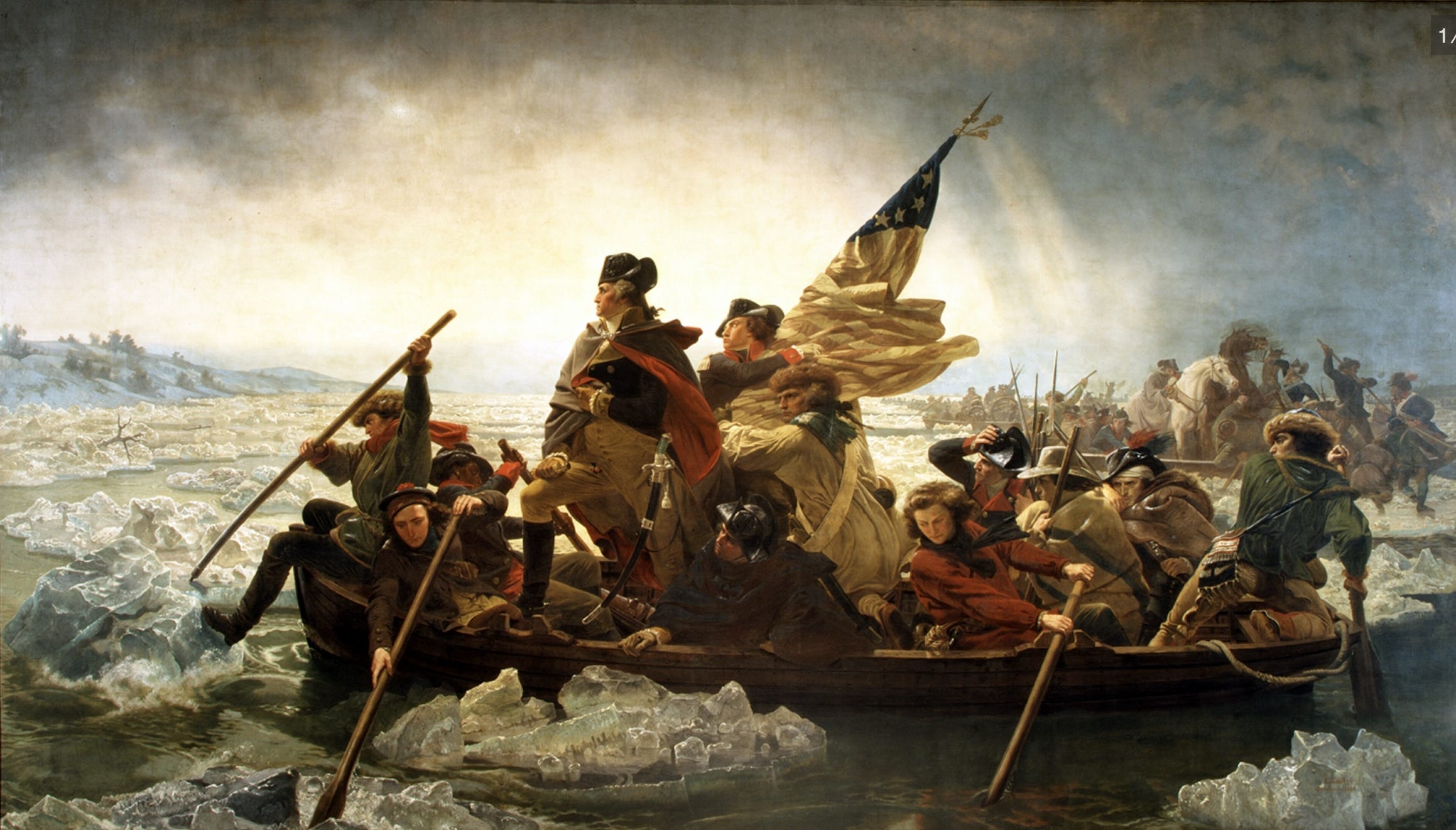
Emanuel Leutze
Washington Crossing the Delaware 1851
Metropolitan Museum of Art
The American Revolution was sparked by a complex mix of economic, political, and social tensions that reached a breaking point in the late 18th century. While the conflict is often boiled down to "taxation without representation," the roots of the rebellion ran much deeper.
Ideological Shifts (The Enlightenment)
The intellectual landscape of the colonies was changing. Leaders like Thomas Jefferson and John Adams were heavily influenced by Enlightenment thinkers like John Locke. Concepts of “natural rights” (life, liberty, and property) and the “social contract”—the idea that a government only has power as long as it protects the rights of its people—provided the moral framework for revolution.
So I asked AI to compare America today and the American Revolution in context of Neil Howe’s The Fourth Turning is Here, as I re-read for the third time.
Neil Howe’s work, particularly in The Fourth Turning is Here, posits that history moves in a recurring cycle of four “Turnings,” each lasting roughly 20 to 22 years. He identifies the American Revolution not just as a war, but as the “Crisis” phase (the Fourth Turning) of the Revolutionary Saeculum.
When comparing the themes in his latest work to the era of the American Revolution, several striking commonalities emerge based on his generational theory.
1. The Breakdown of Institutional Trust
In both the current era and the years leading up to 1776, Howe identifies a “High” that has completely decayed.
The Revolution: The established order of the British Empire and colonial governance lost legitimacy. What once provided security was seen as oppressive or dysfunctional.
Today: Howe argues we are in a similar period where public trust in Congress, the media, and the financial system has bottomed out, creating a vacuum that demands a new social contract.
2. The Rise of “Hero” and “Artist” Archetypes
Howe’s theory relies on the interaction of generational archetypes.
The Revolution: The “Hero” generation (the G.I.s of their day) were the young soldiers of the Continental Army—disciplined, collective-minded, and willing to sacrifice for a new civic identity.
Today: Howe views Gen Z as the modern “Hero” archetype. Like the youth of the 1770s, they are characterized by an increasing drive for community, rule-following (within their own cohorts), and a demand for institutional overhaul.
3. The “Big Threshold” of Social Consolidation
A core theme in The Fourth Turning is Here is that “Crisis” eras are not just about destruction; they are about simplification and consolidation.
1776: The complex, nuanced debates of the 1760s were stripped away until only one question remained: independence or loyalty? Society polarized into two camps, eventually forcing a unified (albeit bloody) resolution.
Modern Day: Howe suggests we are reaching a similar “gate,” where the culture wars and political fragmentation will eventually be forced into a singular, high-stakes conflict or choice that defines the nation for the next century.
4. Total Social Mobilization
In his analysis of the American Revolution, Howe emphasizes that the Fourth Turning requires “total” involvement.
Communal Effort: Just as the Revolution required the creation of the Continental Association and local committees of safety, Howe notes that modern Crises usually involve a massive expansion of government or collective power to meet a perceived existential threat.
The Culmination: Both eras share the “climax” structure—a period of 3 to 5 years where the threat (whether the British Crown or modern economic/political collapse) reaches a breaking point that resets the “seasons” of history.
*Fraudsters abound on Substack Finance. Do not fall for scammers asking to participate in private investments etc. Report imposters via these instructions.
Daily Stock Markets covered in under 15 min. No ads. No partisan politics! Easy to follow for your morning coffee, dog walk or commute
Full Episode: 8 min
Please remember to ❤️
🎧 Podcast Available on all major platforms: Spotify | Apple | Amazon


